
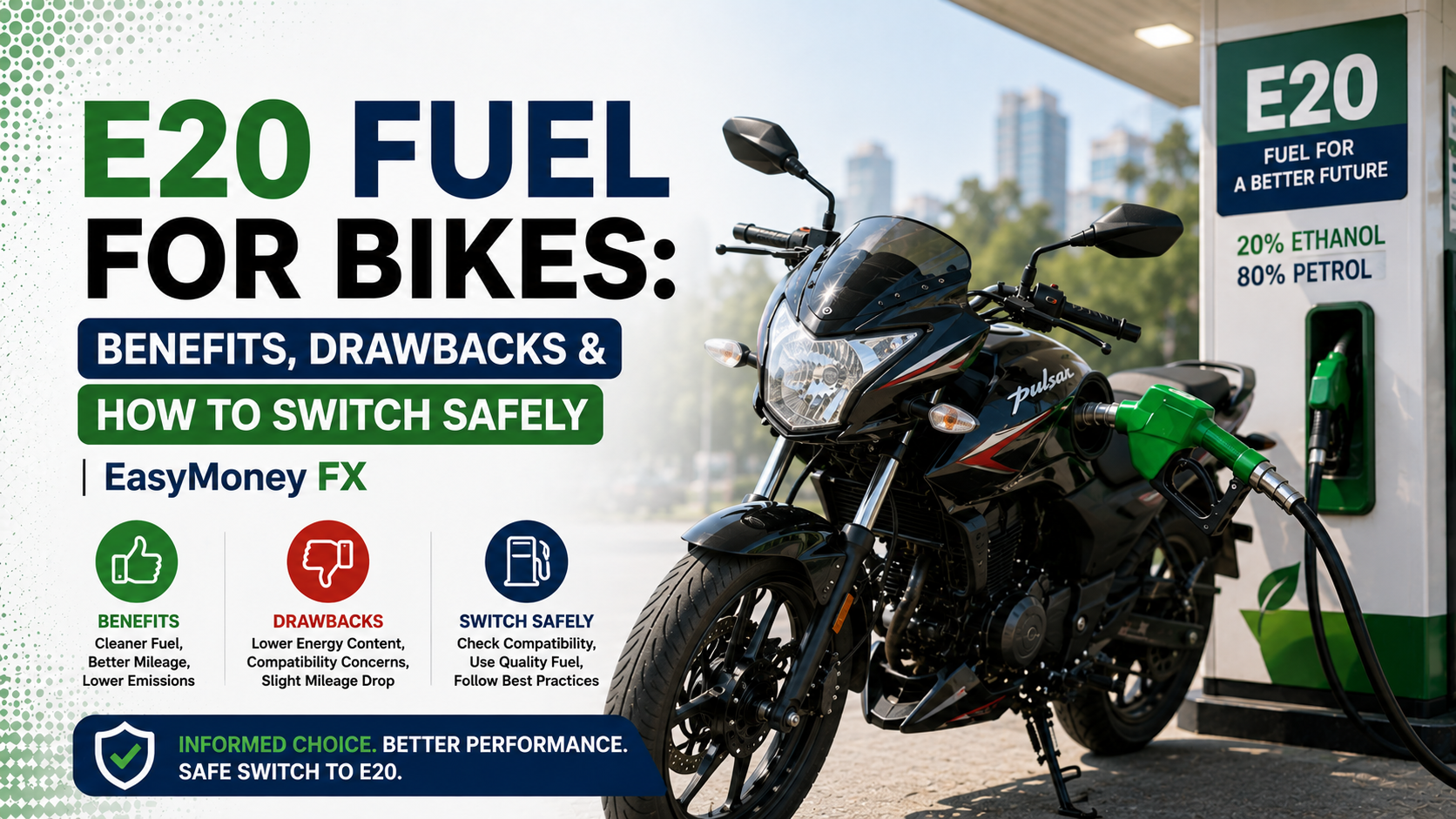
E20 Fuel for Bikes: Benefits, Drawbacks & How to Switch Safely
Most people filling up at a petrol pump haven't thought much about what's actually in the fuel. That's changing. E20 is arriving at more stations every month, and bike riders across India are noticing — sometimes because of a mileage drop they didn't expect, sometimes because someone told them their old bike might not handle it. Here's what's actually going on.
What Is E20 Fuel?
The name tells you most of it. E20 means 20% of what's in the tank is ethanol — an alcohol made from agricultural crops like sugarcane and maize — and the remaining 80% is regular petrol. The blend burns cleaner than pure petrol because ethanol combustion produces fewer harmful byproducts. That's the environmental angle. The economic one is that ethanol is made domestically, which reduces how much crude oil India needs to import every year.
The Mileage Drop: What the Numbers Actually Say
This is where the debate gets real. The government quotes a 3–6% mileage drop. Riders on the ground are reporting 10–25% drops. Both numbers are technically true — they're just measuring different things. (says by Forbes India Blog)
The science behind it comes down to calorific value — how much energy a litre of fuel actually contains. Ethanol has less energy per litre than petrol, so the more ethanol in the blend, the less energy per fill-up.
| Fuel Type | Ethanol % | Energy (MJ/L) |
| E0 (Pure Petrol | 0% | 34.2 MJ/L |
| E10 | 10% |
33.2 MJ/L |
| E20 | 20% |
32.2 MJ/L |
Mathematically, moving from E0 to E20 means roughly a 6% energy drop per litre. Lab tests run in ideal conditions show 3–6%. Real roads with potholes, traffic braking, and varying fuel quality at pumps push that number higher — sometimes significantly. Add in fuel adulteration at certain stations and moisture contamination in underground tanks, and some riders genuinely are seeing 20%+ drops.
The Real E20 Advantages Worth Knowing About
Cleaner Combustion
Ethanol burns more completely than petrol, producing fewer unburned hydrocarbons and less carbon monoxide. For two-wheelers — which make up a massive proportion of India's road traffic — cleaner combustion at scale means real air quality improvement in cities. Over time, cleaner burning also means less carbon buildup inside the engine, which can improve longevity on compatible bikes.
Snappier Throttle Response
Ethanol contains more oxygen than petrol. More oxygen means faster, more complete combustion when the throttle opens. Riders who've run E20 on compatible bikes often notice the difference in city traffic — the bike feels more immediate to small throttle inputs, particularly useful when overtaking or pulling away from signals quickly.
Domestic Supply Stability
Crude oil prices are set on international markets and affected by geopolitical events completely unrelated to India. Ethanol prices are driven by domestic crop supply, which is more controllable. Long term, a higher ethanol blend means India's fuel prices are less exposed to external shocks — one of the less-discussed but meaningful E20 advantages for everyday riders who feel every petrol price hike.
How to Switch to E20 Without Running Into Problems
The switch itself isn't complicated. What goes wrong is usually one of a few things — and all of them are avoidable.
1. Check if your bike is actually E20-ready
Don't assume — open the owner's manual or call the manufacturer's service line directly. Bikes built before 2023 vary significantly in what their fuel systems can handle, and guessing compatibility has caught more than a few riders off guard.
2. Don't jump straight from E10 to E20
Fill one tank, ride it normally, and pay attention. Notice any change in how the bike starts, pulls, or responds to the throttle before committing to the next fill. A gradual transition gives you something to compare — a sudden switch gives you nothing to go on if something feels off.
3. Shorten your maintenance intervals
E20 is harder on rubber components than E10 or pure petrol. Hoses, seals, and fuel filters are where the wear shows up first — especially on older bikes. Checking them more frequently in the first few months catches problems before they turn into replacements.
4. Don't let fuel sit in the tank
Ethanol actively absorbs moisture from the air over time. Leave E20 sitting in the tank for three to four weeks without riding and you're creating conditions for phase separation — where water and fuel stop mixing properly and the engine starts playing up. Run the bike every week or two, or drain the tank if you know it's going to sit unused.
5. Choose your pump carefully
Fuel quality varies more than people realise, and E20's tendency to absorb water makes it more vulnerable to contamination than pure petrol. Stations with high turnover and proper storage infrastructure give you more consistent fuel — and that consistency shows up directly in your mileage and engine behaviour.
6. Listen to what the bike is telling you
Harder starting, a knock that wasn't there before, hesitation mid-throttle, unexpected stalling after switching fuel — none of these are things to ride through and hope go away. They're early warnings. Acting on them early is considerably cheaper than acting on them late.
E20 Fuel Price in India — What to Expect
The e20 fuel price in India at the pump is currently very close to regular petrol — the per-litre difference is small enough that most riders don't notice it at the time of filling. Where the cost difference shows up is over distance. A 5–8% mileage drop means you're covering less ground per litre, which effectively raises your real cost per kilometre even if the pump price looks similar.
The long-term expectation from the government is that as domestic ethanol production scales up, the e20 fuel price in India could become more stable than pure petrol — less exposed to crude oil price swings. That's a genuine potential advantage, but it's a few years away from being consistently visible at the pump.
E20 Fuel Additives — When They're Worth It and When They're Not
Daily riders who fill up regularly don't need them. E20 behaves fine on its own when the tank isn't sitting idle.
The case for additives is more specific — bikes parked for weeks, riders in humid or coastal areas, and older engines that predate ethanol blends entirely. In those situations, ethanol quietly pulls moisture from the air and into the fuel. Left alone, that turns into hard starting, rough running, and eventually a full tank drain to fix.
A stabiliser prevents all of that for a fraction of what the problem costs to sort out. If none of those situations apply to you, skip it. If any of them do, it's worth having.
FAQS
What is E20 fuel price in India compared to regular petrol?
At the pump, you'll barely notice a difference. Where it actually shows up is on your mileage — E20 gives you less distance per litre, so over time you're quietly spending more even though the price tag looked the same.
What are the main E20 advantages for daily bike commuters?
Cleaner exhaust, better knock resistance, and a throttle that feels more responsive on compatible bikes. City riders also tend to see less carbon buildup inside the engine over the long run — which quietly reduces how often the bike needs attention.
Why is the real-world mileage drop bigger than what the government says?
Because lab tests don't have potholes, traffic jams, or dodgy fuel quality. Real riding conditions — plus the moisture contamination issue at some pumps — push the actual drop well past the official 3–6% number.
