
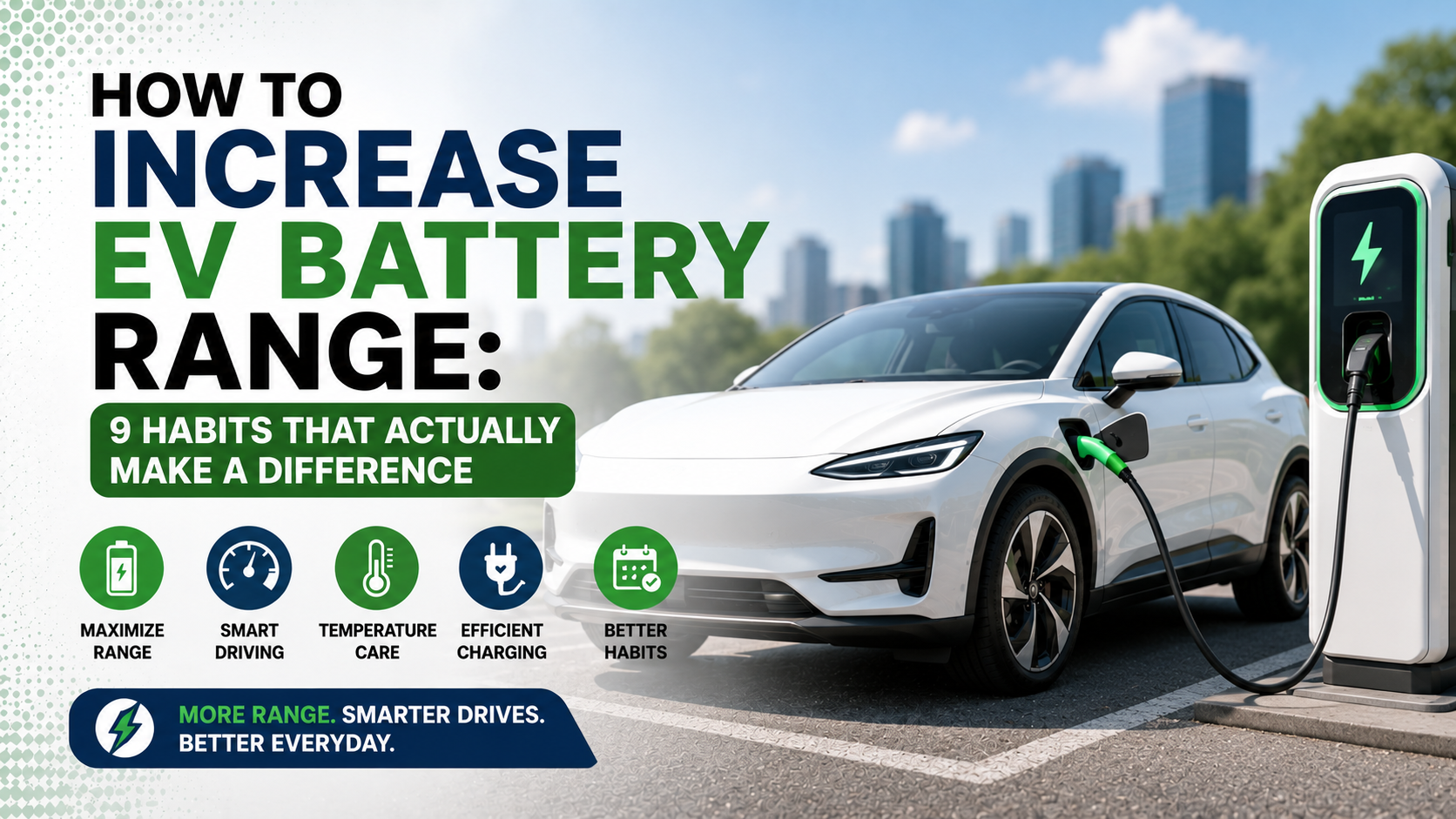
How to Increase EV Battery Range: 9 Habits That Actually Make a Difference
Most EV batteries last 3–5 years with average habits. These nine habits can stretch that to 8–10 years — without spending anything extra.
A lot of EV owners find out the hard way that battery range isn't just about which car you buy — it's about how you use it. The same vehicle, driven and charged differently by two people, can show meaningfully different range and battery health after three years. The good news is the habits that protect your battery are simple, and most of them cost nothing to start.
Here's a practical look at how to increase EV battery range and keep your battery healthy for the long run — covering everything from daily charging to how heat quietly does the most damage.
Habit 1:
The 20–80% Rule — Why Charging to Full Every Night Is Actually Hurting Your Battery
Most people assume a full charge every night is the responsible thing to do. It isn't.
Lithium batteries don't like sitting at maximum voltage for long periods. Doing it repeatedly — night after night — puts constant stress on the cells, and that stress adds up quietly over months before you notice it in reduced range. The same goes for running it to zero before plugging in. That's old thinking from a different battery era and it doesn't apply here.
The 20–80% range is where your battery is most comfortable. Set a charge limit in your car's app, leave it at 80%, and stop thinking about it. The only time 100% makes sense is the night before a genuinely long trip — not as a standing daily habit.
Habit 2:
Let the Battery Breathe Before You Plug In
DC fast charging is useful. It's also one of the quickest ways to shorten your battery's life if you use it the wrong way.
The problem isn't the speed — it's the heat. Pushing a large amount of current through the battery in a short window generates significantly more heat than a slow overnight charge. One session isn't going to damage anything. But use it as your main daily charger for a year or two, and the gradual wear shows up exactly where you don't want it — in range you can't get back.
Home AC charging is slow by design, and that's the point. The battery barely registers the load, temperatures stay low, and the cells handle thousands of cycles without nearly as much stress. Reserve fast charging for the highway. Use the home charger for everything else.
Habit 3:
Let the Battery Breathe Before You Plug In
After a long drive — especially in summer — the battery pack is warm. In some cases, quite warm. Connecting a charger immediately means you're adding electrical load to a battery that's already dealing with heat from the drive.
Individually, it's not a serious problem. As a consistent habit repeated hundreds of times over years of ownership, it contributes to the kind of gradual degradation that's hard to trace back to any single cause.
The solution is a 30–60 minute gap between parking and plugging in. The battery cools, the temperature normalises, and then it charges in far better condition than it would have ten minutes after you pulled in. If you're home for the evening anyway, the wait costs you nothing.
Habit 4
Heat Is the Battery's Biggest Enemy — Park Smart
Of all the factors that affect EV battery life cycle, heat is the one that does the most quiet damage. A car sitting in direct sunlight for hours in Indian summer heat is stressing the battery even when the vehicle isn't being driven.
Parking in shade or a covered space wherever possible makes a genuine difference. If your vehicle has a pre-conditioning feature — which cools or heats the cabin while still plugged in — use it before driving instead of relying on the battery to manage cabin temperature on the move. Starting a hot drive in an already-cooled car is both more comfortable and easier on the battery.
Habit 5
Set Up Scheduled Charging — Let the App Do the Work
Most modern EVs and charging apps let you set a charging schedule — you tell it when to start and what level to stop at, and it handles everything automatically. This is one of the most underused features in EV ownership.
Set it to charge overnight during off-peak hours, stop at 80%, and you wake up every morning with a charged car that hasn't been sitting at 100% all night. The ev battery management system in your car handles the rest — this feature exists specifically to protect long-term battery health without you having to think about it daily.
Habit 6
Leaving the Car Parked for Weeks? Charge It to 50–60% First
If you're going to leave the car unused for an extended period — a holiday, a business trip, anything more than a few weeks — don't leave it at 100% or near zero. Both extremes put unnecessary stress on the battery when it's sitting idle.
The ideal long-term storage charge level is 50–60%. At that level, the battery is relaxed — not straining at maximum voltage, not starved of charge. This is a small thing that makes a disproportionately large difference to the EV battery life cycle over years of ownership.
Habit 7
Keep Your Software Updated
This one surprises people. EV software updates aren't just about new features or interface changes — many of them include improvements to the ev battery management system itself. Manufacturers push updates that refine how the battery charges, how it manages heat, and how it distributes load across cells.
Skipping updates means your car's battery management is running on older logic, potentially missing efficiency improvements the manufacturer has already solved. Keeping software current is one of the easiest ways to maintain EV battery health without any physical effort at all.
Habit 8
Smooth Driving Protects the Battery More Than You'd Think
Aggressive acceleration and hard braking don't just drain the battery faster in the moment — they generate excess heat inside the battery pack, which adds up to real degradation over time. Hard driving is essentially the road equivalent of fast charging: high demand, high heat, faster wear.
Eco mode and smooth acceleration aren't just about saving range on a single trip. They're about how much heat your battery deals with over thousands of kilometres. Regenerative braking helps too — it converts braking energy back into charge instead of wasting it as heat through the brake pads, which is better for both range and battery health simultaneously.
Habit 9
Know Your Battery Type — LFP and NMC Need Different Care
Not all EV batteries are built the same, and knowing which type your car has changes some of the advice above slightly.
LFP (Lithium Iron Phosphate) |
NMC (Nickel Manganese Cobalt) |
|---|---|
| More durable overall. Handles frequent charging better. Actually benefits from occasional 100% charges to recalibrate the battery management system. Generally more tolerant of heat and fast charging than NMC. | Offers better range per charge. More sensitive to high voltage and heat. The 20–80% charging habit matters more here. More prone to long-term EV car battery degradation if frequently charged to 100%. |
Check your owner's manual or the manufacturer's app to find out which battery type your vehicle uses — it takes two minutes and makes the rest of these habits more targeted.
Frequently Asked Questions
How to increase EV battery range without spending anything?
Change two things: how you charge and how you drive. Holding charge between 20–80%, using a home AC charger daily, and switching to eco mode with smooth acceleration will produce a visible difference in range — no upgrades, no accessories. The gains come from reduced heat and stress on the battery, not from anything you buy.
Does fast charging damage EV battery if used just a few times a week
A few times a week is where it starts to matter. Occasional use on a road trip is completely fine — that's the right context for it. But making it a regular part of the weekly routine means the battery is dealing with high-heat charge cycles far more often than it should be. The damage is slow and cumulative, not immediate.
How to maintain EV battery health through Indian summers?
Heat is a bigger factor in India than most EV content accounts for. Park in shade wherever possible. Use your car's pre-conditioning feature while it's still plugged in — cooling the cabin before you drive rather than draining the battery to do it on the road. Wait before charging after hot drives. These aren't complicated habits, but in a climate where temperatures regularly cross 40°C, they make a real difference to how the battery holds up over years.
What is a realistic EV battery life cycle with good habits vs without?
With good habits — the 20–80% charge range, minimal fast charging, heat management — most batteries comfortably retain 75–80?pacity across 8–10 years. Without them, the same battery in the same car can show noticeable degradation by year four or five. The physical battery is identical in both cases. The difference is entirely in how it's treated.
What actually causes EV car battery degradation the fastest?
Heat — and the habits that create it. Frequent fast charging, daily 100% charges, aggressive driving, and parking in direct sun are all variations of the same problem. EV car battery degradation rarely comes from one bad day. It's the slow accumulation of small thermal stresses across thousands of cycles that nobody notices until the range number starts dropping.
What does the EV battery management system actually control
More than most people realise. It monitors individual cell temperatures, controls how fast the battery accepts a charge, balances load distribution across the pack, and decides when to throttle charging to protect the cells. When manufacturers push software updates, a significant portion of those updates are improvements to this system — better thermal logic, smarter charge curves, tighter cell balancing. Running outdated software means your battery is being managed by rules the manufacturer has already improved on.
