
Overview
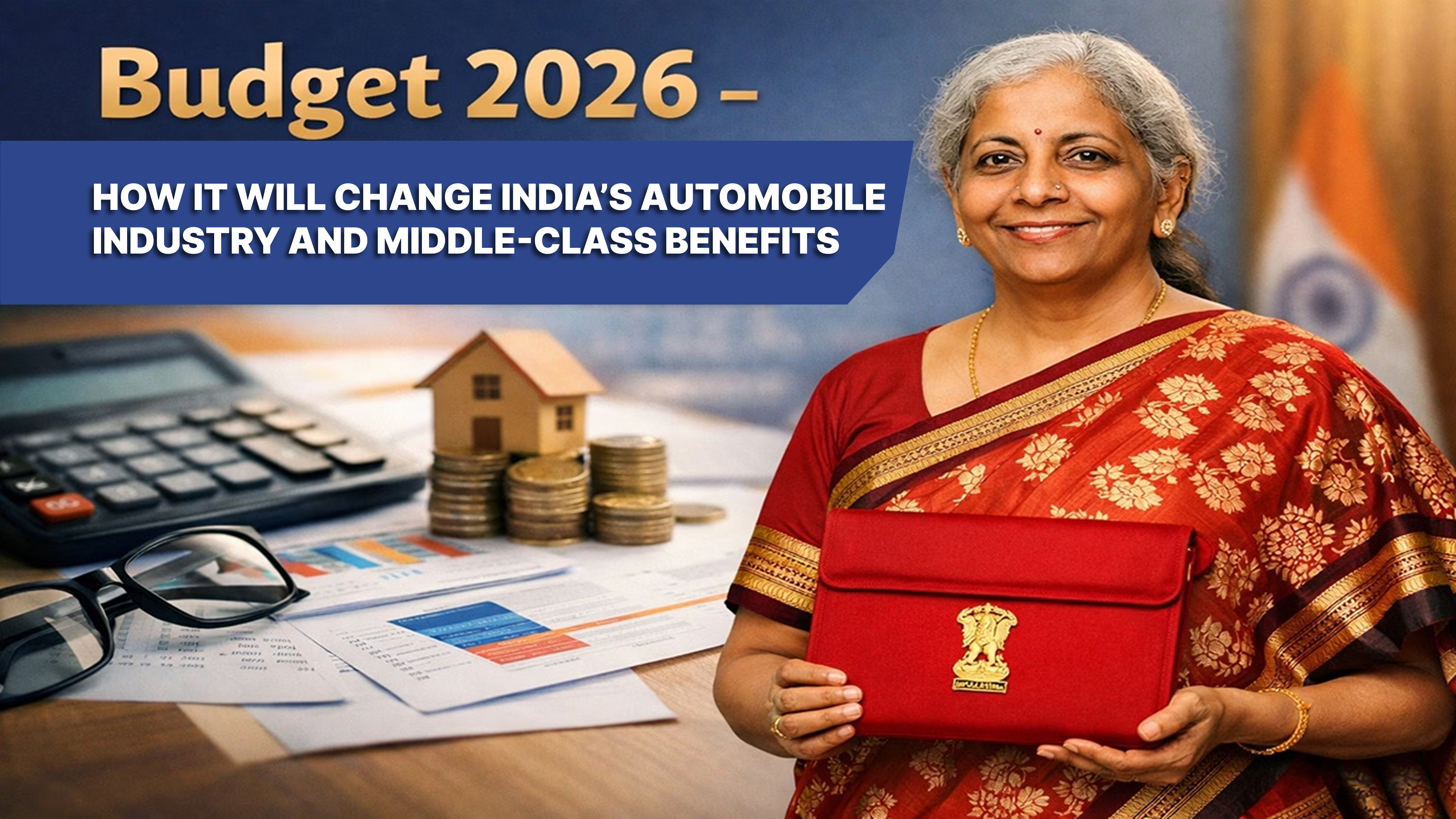
Budget 2026 on cars explained! We break down the 2026 budget for the automobile sector, including GST rationalization, EV battery duty cuts, and what the middle class stands to gain.
Most discussions around Union Budget 2026–27 focus on tech and creative industries. However, one of the most important and quiet changes in Budget 2026 automobile sector could directly impact middle-class families, daily commuters, vehicle buyers, and transport workers.
The 2026 budget on automobile India is laying the foundation for a self-reliant, smarter, and more affordable automobile ecosystem—covering electric vehicles, semiconductors, battery production, and MSMEs. In this blog, we break down the automobile sector budget 2026 and its real impact on consumers, businesses, and the future of mobility.
A Clear Direction for the Automobile Industry
The Budget 2026 automobile sector is not about short-term discounts or quick incentives. Instead, it provides a long-term strategic direction.
The government’s aim is clear: India should not only assemble or import vehicles—it must build the entire automobile ecosystem domestically.
This includes:
Electric vehicles (EVs)
Battery manufacturing and critical mineral processing
Semiconductor chips for smart vehicles
Auto components and parts
MSMEs supporting vehicle supply chains
By connecting all these components into one integrated system, the automobile sector budget 2026 strengthens India’s self-reliance, reduces import dependence, and boosts domestic manufacturing.
Making Electric Vehicles Affordable
EVs remain expensive mainly due to battery costs, which make up 35–40% of the total EV price.
Key Measures in Budget 2026 for EVs
Customs duty exemption on machinery for lithium-ion battery manufacturing
Duty-free imports of equipment to process critical minerals such as lithium, cobalt, and rare earth elements
Why This Matters
Currently, India depends almost entirely on imports for processed minerals. By supporting local processing and manufacturing, the 2026 budget on automobile India reduces production costs.
Impact on Consumers
Gradual reduction in EV prices
Lower battery replacement costs
Improved after-sales service and warranties due to local factories
While this is not an overnight change, it lays a strong foundation for long-term affordability, ensuring car rates after Budget 2026 gradually become more accessible to middle-class buyers.
Fuel Cost Relief: Biogas-Blended CNG
The Budget 2026 automobile sector also addresses daily commuting costs. The government announced full excise duty exemption on the biogas portion of biogas-blended CNG, which can reduce retail prices by ?2–3 per kg.
Who Benefits
Taxi and cab drivers
Auto-rickshaw operators
Daily commuters
Households using CNG vehicles
Even a small reduction has a direct impact on household budgets, showing that automobile sector budget 2026 reforms are designed to touch everyday lives, not just industry factories.
Strengthening Supply Chains: Semiconductors and MSMEs
Today's cars function as rolling supercomputers depending heavily on advanced semiconductors to power critical features like advanced driver-assistance systems, GPS guidance, energy control in batteries, environmental monitoring, and self-driving technologies
Key Announcements from Budget 2026 for the Automotive Sector
India Semiconductor Mission 2.0 (ISM 2.0): Upgraded version now encompasses production of chip-making tools and raw inputs, plus creation of complete indigenous semiconductor intellectual property.
Electronics Manufacturing Scheme: Funding boosted significantly from ?22,919 crore to ?40,000 crore.
MSME Assistance: Introduction of a ?10,000 crore dedicated SME Growth Fund, improved cash flow through expanded TReDS platform, plus dedicated compliance guidance via Corporate Mitras operating in smaller cities and towns (Tier-II and Tier-III).
Impact:
Reduced risk of chip shortages
Stronger domestic supply chains
Job creation beyond metro cities
A more resilient automobile sector
Rare Earth Corridors for EV Security
The government plans rare earth corridors in Odisha, Kerala, Andhra Pradesh, and Tamil Nadu to cover the full value chain from mining and processing to research and manufacturing.
Benefits:
Stable EV battery material supply
Reduced import dependence
Lower exposure to global price fluctuations
This demonstrates that Budget 2026 automobile sector measures are forward-looking, beyond short-term incentives.
Justice for Accident Victims
A major human-focused reform in automobile sector budget 2026:
Compensation and interest from Motor Accident Claims Tribunal (MACT) awards are now 100% tax-free
TDS has been completely removed
The Supreme Court flagged this issue in 2022 and 2024, emphasizing that deductions were unfair to victims, especially those not paying income tax.
Now, the full amount reaches families directly and fully, making this reform socially responsible and people-centric.
Where the Budget Falls Short
While the 2026 budget on automobile India sets a strong direction, some gaps remain:
EV charging infrastructure is uneven and unreliable
Industry-ready skilled manpower is still in short supply
Vehicle affordability is incomplete without affordable loans and predictable insurance
Even though Budget 2026 highlights in Hindi and official statements emphasize manufacturing and EVs, real-world execution is key for middle-class impact.
Conclusion
The Budget 2026 automobile sector provides a clear, future-focused path for India’s vehicle ecosystem. It strengthens local manufacturing, supports MSMEs, reduces long-term costs, and ensures justice for accident victims.
However, true middle-class mobility will only improve if:
EV charging networks become reliable
Skilled workforce is developed
Affordable vehicle financing and insurance are ensured
The intent is strong, but execution will determine whether car rates after Budget 2026 and broader automobile reforms truly reach ordinary families—or remain on paper.
What do you think?
Will the automobile sector budget 2026 transform everyday mobility, or will these reforms stay theoretical? Share your thoughts below.
If you want to check your vehicle’s current market value instantly and for free, use Easy Money’s quick valuation tool here: easymoneycarloan.com/get-your-car-valuation
Join thousands of vehicle owners who are making smarter buying and selling decisions with accurate, AI-backed valuations in just seconds.
